Your Older Child Isn't Acting Out — They're Mourning
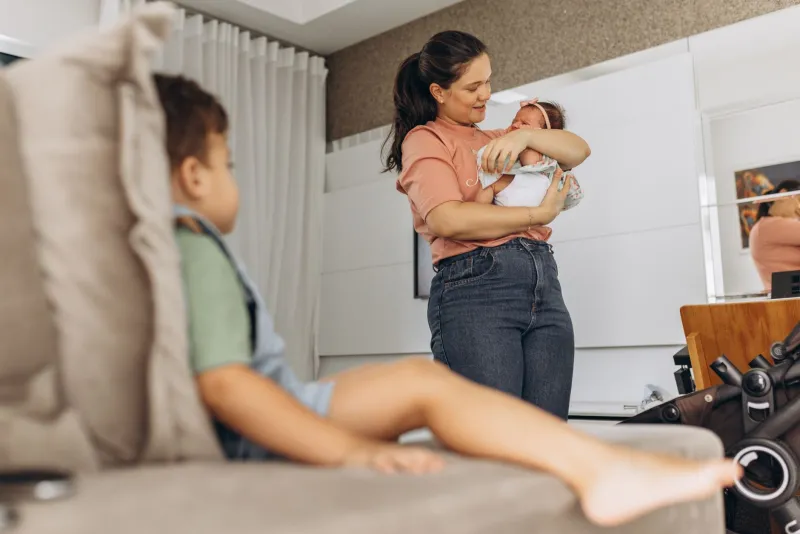
Somewhere around week three of life with a new baby, the regression started. Maya, age four, began wetting the bed again. She started speaking in a baby voice she'd abandoned a year earlier. She clung to her mother's leg during nursing sessions and pitched meltdowns over nothing — a wrong-colored cup, a sock that felt funny, a cracker that broke in half.
Her parents, exhausted and stretched thin, tried everything: special big-kid privileges, extra attention during nap time, patient explanations about how much the family loved her. Nothing quite worked. The behavior kept escalating.
"We kept framing it as jealousy," her mother, Priya, recalls. "But one night she said something that stopped me cold. She said, 'I just miss you, Mommy. The old you, before the baby.' And I realized — she wasn't jealous of her brother. She was grieving me."
The Loss That Doesn't Have a Name
When we talk about siblings adjusting to a new baby, the conversation tends to stay surface-level: expect regression, carve out one-on-one time, praise the big kid role. This advice isn't wrong, but it skims past something deeper and more important — the genuine grief that older children can experience when a new sibling arrives.
Grief might sound like a dramatic word for a four-year-old's feelings about a baby. But child development specialists use it deliberately. A new sibling doesn't just add something to a child's world. It removes things: undivided parental attention, an established family identity, daily rhythms that felt safe and predictable, and a particular version of themselves within the family structure.
"We're asking children to absorb a loss — multiple losses, really — at the same time we're celebrating a gain," says Dr. Annika Torres, a licensed child psychologist in Denver who specializes in family transitions. "And we're often not giving them permission to grieve because the event is supposed to be happy."
The result is children who act out in confusing ways, whose behavior parents read as defiance or manipulation, when what's actually happening is something much more tender: a child trying to process a seismic shift without the language or emotional tools to name it.
What the Older Child Has Actually Lost
To understand what's happening for your older kid, it helps to get specific about what has genuinely changed in their world.
Their primary relationship has been restructured. For most first-born or previously youngest children, their relationship with their parent or parents was the central axis of their daily life. That relationship hasn't disappeared, but it has been fundamentally altered — divided, interrupted, and depleted — in ways they can feel but not articulate.
Their identity within the family has shifted. Children build a strong sense of self around their role in the family. "I'm the baby" or "I'm the only one" carries real psychological weight. When that identity is suddenly renamed — "now you're the big kid" — it can feel less like a promotion and more like a displacement.
Their routine has been disrupted. Young children are hardwired to find safety in predictability. A new baby upends nearly every routine in the household, and for a child who couldn't anticipate that change or consent to it, the loss of structure is genuinely destabilizing.
Their parent is different. This one is hard to sit with, but it's real: a parent caring for a newborn is often physically depleted, emotionally stretched, and less available in the specific ways their older child has come to depend on. The child isn't imagining this. The parent has changed, at least temporarily — and that's a loss worth naming.
Why We Reach for 'Jealousy' — And Why It Falls Short
Jealousy is a tidy label for a complicated emotional experience. It positions the older child as the problem — as someone who needs to be managed, redirected, or corrected — rather than someone who is hurting and needs to be met.
When we tell a child "you don't need to be jealous, we love you just as much," we're answering a question they didn't actually ask. They aren't questioning whether they're loved. They're mourning what's been lost. Those are different things, and they require different responses.
"Reassurance doesn't land when a child is in grief," Dr. Torres explains. "What lands is acknowledgment. Saying 'I know things feel really different now, and that's hard' does more than any amount of 'but we love you so much' ever could."
Frameworks That Actually Help
Name the loss out loud. Give your child language for what they're experiencing. "Our family used to be just us three, and now it's different. That's a big change, even when it's also exciting." Naming the loss doesn't amplify it — it gives the child permission to feel it without shame.
Resist the rush to silver linings. When an older child expresses sadness or anger about the baby, the instinct is to redirect toward positivity: "But you get to be a big sibling! That's so special!" Try sitting in the hard feeling for a moment before pivoting. "You miss how things used to be. Tell me more about that."
Protect their identity beyond the sibling role. "Big brother" and "big sister" are meaningful identities, but they shouldn't be the only lens through which we see older children during this transition. Make sure they have space to just be themselves — their interests, their friendships, their individual relationship with you — that exists completely independently of the baby.
Bring them into the story without making them responsible for it. There's a difference between including an older child in the family's new chapter and burdening them with the emotional labor of modeling acceptance or happiness they don't feel. Invite participation; don't require performance.
Watch for grief that needs more support. Most children move through the adjustment with time and consistent, empathetic parenting. But if your child's distress is intense, prolonged, or affecting their eating, sleeping, or friendships, consider connecting with a child therapist. A few sessions during a major transition can be genuinely preventive.
The Long Game
Maya is seven now. She and her brother are close in the complicated, physical, relentless way of young siblings. But Priya still thinks about that conversation — I miss you, the old you — and what it taught her about what her daughter actually needed.
"I stopped trying to convince her things were fine and started just sitting with her in the feelings," she says. "It didn't fix everything overnight. But she stopped acting out so much once she felt like her grief was real to me too."
Your older child's adjustment to a new sibling isn't a problem to be solved. It's a loss to be witnessed. And sometimes, being witnessed is the whole thing.